Saturday, September 24, 2022

What happened last summer?

The current lull in Meryl project news has been one of the longest I can remember since I started this blog. She took all of 2016 off from filming, but Florence Foster Jenkins came out that summer, she ended up getting nominated for it in the winter, and a few months later we had news of the The Post which was then released nine months later). She hasn't filmed a movie since late 2020 (maybe into January 2021). We're still waiting for news on when exactly Extrapolations will be released on Apple TV+, but even with that, her role in it may be small. 

All this recently got me thinking about the fact that as late as spring of 2021, a lot of us were reasonably expecting that Meryl would be filming Places, Please in the summer, with the additional possibility of two supporting roles in Damien Chazelle's Babylon and Ari Aster's Disappointment Blvd. Both of the latter two projects filmed in the summer.  And with them both being smaller roles, I suspect Meryl's filming contract could've carved out schedule for her to participate had she wanted to. Alas, Places, Please never happened and Jean Smart and Patti LuPone ended up taking the roles Meryl would've likely been up for in Babylon and Disappointment Blvd., respectively.

The fact that Places, Please was announced in February 2021 with an expected summer filming schedule (director attached) makes me think that they had all the financing in place. There may have been other people already cast as well for all we know. If memory serves, Smart and LuPone were both announced fairly late, relative to the rest of their respective cast members and projected filming schedules. So it makes me wonder when pulling it all together: did something happen last summer?

This is all speculative, of course. But it doesn't seem that wild to picture a life event that may have made Meryl unavailable for several months mid last year. Maybe a health issue, maybe a family issue, maybe some other personal reason. I doubt it would've been because of any Covid reason, as she seemed on board to film Places, Please and she had shot Don't Look Up a few months prior when cases were surging. And then she did a fair amount of press late last year for Don't Look Up, so she seemed fine then.

Whatever reason it didn't start as planned, maybe Places, Please lost some of the cast they had in place and they couldn't just pick up where they had left off this year instead. Maybe Meryl just wanted a longer break and had decided to say no to the aforementioned projects or even others we've never heard of. Or maybe she was never actually cast in Babylon or Disappointment Blvd. and Places, Please just ended up going into development hell. The latter scenario is probably the most plausible. But of course I can't help my brain from wondering, and then of course typing those hypotheses into this blog! 

Fingers crossed we get some news about something (anything!) soon. 

Saturday, September 17, 2022

Recasting 1989 (supporting): "Parenthood"

This might end up being one of my favorite choices during this project, and the first of (spoiler!) more than one Dianne Wiest role I'm selecting. Ron Howard's comedy-drama has been one of my favorites since I was a child. I think I've said before on this blog (I don't remember exactly for which lead recasting selection), that it's interesting to re-watch films as an adult that I enjoyed so much as a kid. Particularly when the film includes children characters who were about the same age as I was when I watched it. Parenthood is definitely one of those movies. And it's a bit funny that when I see it now, I'm pretty much the same age as all the parents. While I'm myself childless, I definitely identify with the parents' struggles with their families and careers paths, a fun turn from my original point of view as a relatively responsibility-free elementary school student. 

The film weaves several concurrent storylines of an extended family in St. Louis, the Buckmans. Helen (Wiest) is a divorced bank manager who struggles with her teen daughter Julie (Martha Plimpton) running away and getting married/pregnant, and her pubescent son, Garry (Joaquin Phoenix) whom she suspects is doing drugs but is really just carting around porn tapes and in need of a male role model. We see Helen's older brother Gil (Steve Martin) struggle with a child with mental illness. Her younger sister, Susan, is in a marriage where her husband's attention is mostly focused on their prodigy five year-old. And a younger brother, Larry, a screw up gambler who shows up out of nowhere with a young black child (a detail that raised more eyebrows thirty years ago than it likely would now) after no one has seen him in years. One of my favorite scenes in all of cinema is when Julie's sex photos of her and her boyfriend get mixed up with Helen's photos from a promotion at the bank:


"And we have the picture's to prove it!" Get's me every time.

None of the family's problems are necessarily out of this world complicated or threatening (except for maybe Larry's life being threatened by teamsters). Most of us have experienced similar conflicts ourselves, or at least have a family member or friend who've gone through something similar. What makes it so interesting is that these are folks who, on the surface, probably have it pretty good. They live in the suburban United States and aren't really worrying about things like putting food on the table or searching for shelter. Very first-world problems. But it's a testament to the fact that despite having the basics, if we don't have stable familial relationships, the threads all too often start to wear. And of course, this film very adeptly succeeds at making it funny and relatable. 

Parenthood was a huge success with both audiences and critics. On a $20 million budget, it earned $126 million at the global box-office. The film was also a critical darling, with a 92% on Rotten Tomatoes and a Metacritic score of 82, indicating "universal acclaim." Wiest deservedly scored Golden Globe and Academy Award nominations for her performance. I had thought at first that Meryl might have been a bit young for this role. Wiest is only a little over a year older than she is, but the mother of a seventeen year-old seemed a stretch for Meryl in 1989. She would've been 39 at the time of filming. But having kids in your early 20s wasn't nearly as young-seeming in the early 70s as it is these days. It actually might have been something that helped inform Meryl's performance had she found herself among the amazing ensemble cast members of this film. 


Saturday, September 10, 2022

"Don't Look Up" wins Humanitas Prize

It was announced yesterday that Don't Look Up has been awarded the Humanitas Prize for Comedy Feature Film. Since 1973, the prize has been awarded "to empower television and film writers whose work explores the human condition in a nuanced, meaningful way." Other winners this year include TV series Black-ish, limited series Pachinko, and animated film Encanto. The award includes a cash prize to the winners' writers (Adam McKay in this case for Don't Look Up).

I've mentioned this before, but it's been nice that despite not being a critical darling last year, Don't Look Up has sort of created a nice little legacy for itself already. It's one of the best-performing films on Netflix in history, and it continues to be recognized for its allegorical message on the perils of climate change. I'm here for it. And it seems the type of thing Meryl is really passionate about. Makes me even more interested to see how Extrapolations turns out this fall. Now can we get a trailer and release date already?!


Tuesday, September 6, 2022

Recasting 1988 (supporting): "Working Girl"

We're back on track with a more conventional, well-known selection. It's known that Meryl was in consideration for the role of Katharine Parker in Mike Nichols's 1988 dramedy, Working Girl. I've been a fan of this movie dating back to high school. My mom brought it home on VHS one day and it's been a favorite of ours since. Having first seen it nearly a decade after its release, I had forgotten how popular the sort of Wall Street picture was in the 80s. Secret of My Success, Big Business, Wall Street. They're all movies from around that time that I enjoyed, not really realizing they were so representative of the Zeitgeist, with unchecked capitalism and corporate greed all the rage.  

The film follows Tess McGill (Melanie Griffith), who's trying to work her way up the corporate ladder in New York City. After she's set up on a would-be business meeting that turns out to be more like an audition on a Hollywood casting couch, she quits and is offered a secretary position for Katharine Parker (Sigourney Weaver). Tess and Katharine are both about to turn 30 (a stretch for Sigourney and Meryl in 1988), with Tess a few days older. There's an interesting dynamic between the two from the start, with Tess acknowledging that she's never worked for a woman before, nor (presumably) for someone younger. Katharine seems, at first, to be the kind of boss who's going to not only not be a total douche bag tyrant, but also a mentor to Tess in the business. Not so much, as it turns out. 

I watched this movie for the first time in years a couple weeks ago with Joe. I'm sure I've seen it since The Devil Wears Prada came out, but during this most recent viewing, I was immediately struck by the comparisons to be made between the two characters of Katharine Parker and Miranda Priestly. Yes, they're both successful business women in important positions with a female assistant. But there's an interesting paradox in how they're both initially perceived, and then actually turn out to be. The first time we see Katharine is a watered-down version of Meryl's entrance in The Devil Wears Prada, where everyone in the office is sort of laid back until she arrives. But unlike Miranda, Katharine stops to politely introduce herself to her new employee, and early on she makes it known that she's open to Tess's ideas. But when Tess offers a good idea, Katharine (who up to this point we see as a bit snobby but not necessarily evil) shows her true colors and steals the idea. Miranda Priestly wouldn't deign to be as accommodating as Katharine seems to be, but we never get the sense that she's unethical. She might be a bit ruthless, but what you see is what you get with Miranda. Katharine's actually kind of a bad person (not that the men in her business aren't, necessarily) for what she does to Tess. Maybe that's what it takes for someone to reach the position she's reached. But I suspect not. It would've been a fun thing to witness Meryl negotiating this character. I can see her getting the audience to maintain a bit of sympathy or understanding for Katharine, despite her poor treatment of Tess. 

Of course there's a love triangle between Harrison Ford's character, Jack Trainer, and Tess and Katharine. It sort of raises the stakes and adds to the dislike we get for Katharine, now that Jack and Tess have sort of become an item while Katharine was recouping from her skiing accident.  

That scene is so well-played by Weaver. We definitely don't see Meryl portraying characters quite that overtly and confidently sexual. And we certainly don't see her in lingerie. I wonder how close she got to being in this movie. Knowing that she was "considered" could mean a lot of things. She and Mike Nichols had already done Silkwood and Heartburn together. It's certainly possible that she'd read the script. I wonder if she had, if the scene above would've given her pause in considering participating. Alas, we'll probably never know. 

Working Girl did well with critics and was a big box office hit. It received a total of six Oscar nominations, including Best Picture and Director. Griffith and Weaver both received noms as well, along with Joan Cusack, who hilariously portrays Tess's friend, Cynthia. Weaver won the Golden Globe for her performance, a year she famously scored two wins, the other for lead in Gorillas in the Mist.

Tuesday, August 30, 2022

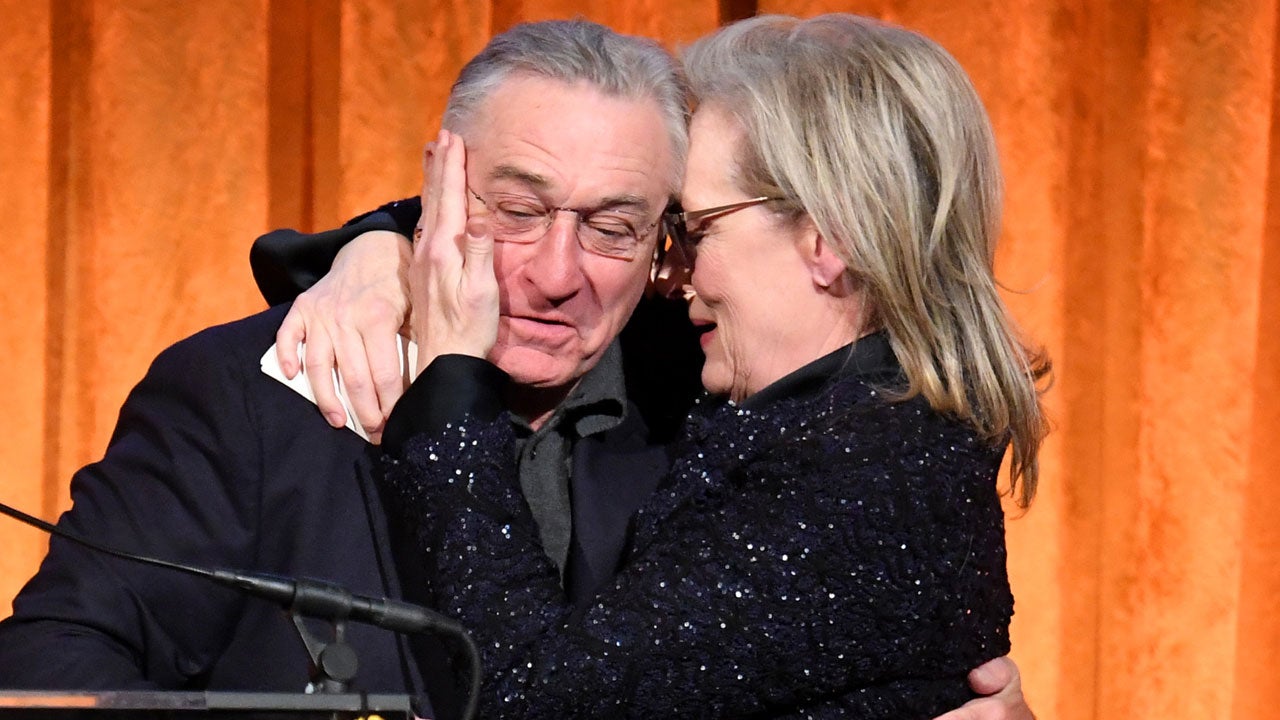
Streep to attend gala in honor of Robert de Niro

Several sources are reporting that Meryl will be attending "A Celebration of Film" at the University of Texas on September 24 to honor Robert De Niro. De Niro has apparently provided a portion of the endowment to the University's film preservation archives, and they're holding a gala to raise additional funds. 

I normally don't report on news like this. I prefer to mostly keep my posts to items relating to Meryl's screen career. Not that it's ever a bad idea to promote good works or charitable contributions, but it's not really the goal of this blog to cover Streep's activities unrelated to her own work. I thought I'd make an exception in this case, however, since we've heard almost nothing about her since the very early part of the year. I've seen speculation online that she's critically ill, that she's decided to retire, that she's separated from her husband. I guess any of those could technically be true for all I know (I doubt any of them are), but I was pleased to see that Meryl is alive and likely well and likely just taking one of her usual extended breaks from filming. 

I'm looking forward to news or release details for her upcoming anthology series Extrapolations. And like I've said recently, it could be any day that we learn of plans for her next big project. Patiently waiting.


Wednesday, August 24, 2022

Recasting 1987 (supporting): "Empire of the Sun"

We continue this supporting recasting project with a selection that most Streepers, upon first reading, will probably think "huh?" It's been fun to go outside of the box a bit with these supporting roles. There's a wider spectrum from which to choose; borderline lead (see Witness) to borderline cameo (Empire of the Sun and--spoiler--my likely upcoming choice for 2011). I first watched Empire of the Sun a couple of years ago when making preliminary selections for which films I might include in this follow-up recasting project. So often I find myself choosing to insert Meryl into roles that not only seem exciting from the character standpoint, but from the backdrop or region of the world in which the movie takes place. Steven's Spielberg's 1987 drama caught my eye for its setting in the less-often portrayed Pacific Theatre of World War II. 

The film is a coming-of-age story that follows the young Jamie Graham (Christian Bale), a British kid living with his rich parents in Shanghai when Japan begins to occupy parts of China in the early 1940s. Jamie gets separated from his parents, and after being taken prisoner, survives by operating a successful trading network in an internment camp. It is here where he develops close relationships with many of the prisoners. He idolizes the American POW camp, especially Basie, an expatriate hustler (John Malkovic), and is sort of reluctantly taken into the "home" of Mr. and Mrs Victor. It's Mrs. Victor whom I've chosen as the role to be recast in this entry. 

Portrayed by Miranda Richardson, the part of shell-shocked Mrs. Victor is one that I've come to learn was likely trimmed down significantly in the editing process. It's a shame too, because while it was never going to be a huge role, there seems to be large enough thread of her character throughout the interment camp scenes (the bulk of the film), that one gets a sense that she was intended to be showcased more in the original script. A British socialite, Mrs. Victor is a sharp contrast to the energy and opportunistic drive that motivates Jamie. She's annoyed by Jamie's naivete and pluck, and half the time looks like she's ready and willing to simply pass on.

We don't fully know whether she's just sad, scared, pissed, or a combination of all three. But the mother-son dynamic is strong enough that she welcomes Jamie back to their bunk after he learns Basie escapes the camp. In some ways, with her quiet and suppressed demeanor in the background (there are tidbits where you can totally get the sense that she's a snooty rich Brit), she's like a ghost figure in the film, her presence weaving through Jamie's experiences and framing them a bit for us in regard to his growing up. 

After the camp is liberated, Jamie makes his way with Mrs. Victor and the rest of the prisoners to a sports stadium filled with confiscated expensive furniture. It's here where Jamie probably completes his "coming of age." Mrs. Victor convinces him to stay put. And as Jamie suggests they "play dead" to not be noticed, he finds that Mrs. Victor isn't pretending in the morning. It's a pretty cool (if sad) scene actually, where the bright light from the Hiroshima bomb is interpreted by Jamie as Mrs. Victor's soul leaving her body. 

Again, it's a shame if it's true that Mrs. Victor was to have a large part in the film. It would've made us care a little more about her death, I think, which only helps the impact of the movie. I realize that this role might seem like there'd be too little for Meryl to do. But I can imagine her in the mid to late 80s making herself available if her agent had given her the script--since it would be working with Steven Spielberg--which up to that point she hadn't. She would've been fascinating to watch in an understated role like this. I would've preferred if there'd been something in The Last Emperor, a superior film released in the same year that also takes place mostly in China, but without it being so much through the scope of a white person. I also wish I would've seen Empire closer to the time that it came out. It would've been extremely easy for me to imagine myself in Jamie's place, having been only a few years younger than he was depicted on the screen. What a whirlwind and frightening journey for someone so young. 

Empire of the Sun wasn't quite the box-office hit like so many of Spielberg's movies had been earlier in that decade. But it received a ton of tech recognition at the Academy Awards and generally did well with critics. The film is beautifully shot. Very much an epic landscape and story. I also happen to think Bale's performance is stunning for someone so young. In general, the film is finely acted, with Miranda Richard's (downsized undersized) performance no exception. 


Wednesday, August 17, 2022

Recasting 1986 (supporting): "The Clan of the Cave Bear"

I warned readers at the start of this supporting recasting project that some of my choices were going to be a bit obscure. My pick for 1986 is one that I suspect few, if any, would've ever guessed. But I seemed to have had this movie in mind rather early on in my selection process. And while it may leave many of you scratching your heads, I'll make an argument for while it would've been a fascinating take for Meryl. 

The Clan of the Cave Bear is the first novel in author Jean M. Auel's Earth's Children series, which depicts interactions between early modern humans and our close relatives, Neanderthals. While I never read the books, I can remember distinctly as a child being drawn to the story of Ayla, a Cro-Magnon girl who is adopted by a clan of Neanderthals somewhere around 30,000 years ago. The draw was less about Ayla herself as a character, but the world. The world that was so long ago that it seemed and still seems like a fantasy. Films around the same time like Legend, The NeverEnding Story and Willow conjured a similar feeling--perhaps naturally, as they're all fantasy films. But I always knew that Neanderthals weren't puppets or fairies or flying pink dragons. They were real. Evidence of their existence remains today. We could hold them in our hands. And it was the first time that I can remember watching an entire film that keenly attempted to showcase what it was like for people in times earlier than my brain is capable of comprehending or contextualizing. 

Daryl Hannah stars as Ayla in the film version, directed by Michael Chapman (All the Right Moves). As a young girl, Ayla is separated from her mother during an earthquake. She is found by Iza (Meryl's recasted character, originally portrayed by Pamela Reed), the sort of medicine woman of a Neanderthal clan. Despite protests from her brother Creb and others, Iza takes Ayla into their clan. It's sort of a big deal for them, as Ayla is clearly one of the "others," meaning a modern human. This spells trouble at times, as Ayla's seemingly superior intellect tends to antagonize some members of the clan. Worrying that Ayla will struggle to find a mate, Iza trains Ayla in her healing ways.    


By today's standards, the costumes and makeup almost look a bit silly. But for almost forty years ago, it's not bad, in fact having earned an Oscar nom for makeup. It has to be said that this film did very poorly with critics and the box office. It's always perplexed me a bit, even as I watch the film again as an adult. There's a quote on Wikipedia taken from The Encyclopedia of Fantasy that reads: 

It is hard to see why TCOTCB has drawn such critical contempt, unless for its tacit feminism: although the narration is overexpository and the equation of mental versatility with leggy blonde Cro-Magnons, as opposed to shabby Neanderthals, is a cliché, the movie is beautifully shot, well scripted and finely acted.

I tend to agree with this sentiment. One thing I find interesting about the film's story is that the interactions among the clan, and even among the clan and "others" isn't all that different than how modern life is in regard to class and group identity. Recent studies suggest that Neanderthals were likely closer in intelligence to modern humans than is historically perceived or depicted. That long-held assumption is of course perpetuated for the most part in this film, with Ayla being better at math as a child, finding the clan a cave, and figuring out a way to survive after giving birth all alone in harsh conditions. So while the comparisons between the two groups may not actually be accurate, the relationships Ayla develops are no different than any adoptive mother and daughter or sister would be nowadays. 

One has to admit, playing a Neanderthal would be unlike any character Meryl has come close to playing. Iza is a complex woman in her own right. And even for a character existing 30,00 years ago, having her own "profession," she's a person of importance with some independence in her community, which carries its own sort of feminist sentiment which I feel Meryl would've appreciated. There's of course the language (made up of course) that is a combination of signs and verbal communication, which I always enjoy watching Meryl tackle. 

It's difficult not to draw comparisons to this film with one released five years earlier, Quest for Fire. Both attempt to tackle the tricky task of depicting a prehistoric culture of our early ancestors. While Quest was far-better reviewed and did better financially, it's not without its criticisms. One being that historically it's absurd that there would be multiple species of early human of varying degrees of evolutionary advancement all living within close proximity of each other at the exact same time. But the premise works greatly in making us ponder the world at a time like that. While I concede that Quest is the better film, this inability to avoid wanting to examine our origins was something I experienced in watching both films. I would've loved to see The Clan of the Cave Bear directed with a vision just as clear and with execution just as consistent as the former. Still, I maintain that it's worth a watch.