For a while, I had been seriously considering choosing this film for my original "lead" recasting project a couple of years ago. I've been a fan of The Prince of Tides since I was in college, when I can remember checking it out from the catalogue of VHS tapes held behind my dorm's front desk. I thought better of the lead recasting, however, when I realized that the role of Dr. Lowenstein (portrayed by Barbra Streisand, who also directed the picture) wasn't all that great of a character to me. Streisand did a wonderful job in the role, of course. But it ultimately became more appealing to me to picture Meryl being directed by Streisand, and taking on a part with a bit more meat to it, that of the social-climbing, manipulative Southern mother, Lila Wingo.
Based on Pat Conroy's best-selling novel, the story follows Tom Wingo (Nick Nolte), who leaves his home in South Carolina to visit his twin sister Savannah in New York after she's attempted suicide (again). Streisand portrays Savannah's psychiatrist, Susan, and she and Tom develop a romantic relationship. In his discussions with Dr. Lowenstein, Tom slowly reveals the details of he and his siblings' tragic upbringing, including the resultant tumultuous relationship with their mother. I read an interview with Kate Nelligan (who portrays Lila) around the time of the film's release, and she described the hesitation she and Streisand had about ageing the character from her late twenties to her sixties. They had originally tested older actresses for the older "version" of Lila, but ultimately decided to use makeup to age Nelligan. I think they made the right choice, as Nelligan (even with early 90s makeup) was believable in both time periods. She is less than a year younger than Meryl as well, so it would've been equally as doable for Meryl in the role. See comparison between the two videos below.
This second video shows Tom discussing "Callanwolde," the prison from which three convicts escaped and sexually traumatized the Wingo family. Imagine having to endure getting raped, seeing your mother and your sister raped, watching your brother kill the perpetrators, and then being told that you can NEVER speak of it. They didn't even tell their father, who was absent at the time of the incident. Whatever kind of pathology that burdened Lila to the point that she felt the best thing to do for her family was to insist that "this never happened," it's amazing that she's able to rationalize her choices by saying she simply doesn't dwell on the past. There's a sad sort of selfishness in that. She put her own desire for upward social mobility in the way of the health and wellness of her children. It didn't even seem like she behaved like she was all that traumatized herself by what happened. But maybe she was? Maybe it's too easy to judge the choice she made to stifle her children's communication about what had happened to them, when she had no other way to deal with her own pain from the experience. It's hard to say. But that would've been an interesting angle to explore for an actor.
The Prince of Tides was a critical and commercial success. It garnered seven Academy Award nominations, although many were left raising an eyebrow that despite its Best Picture nom, Streisand was left off the directing list. Nelligan deservedly scored a nomination for Best Supporting Actress and was runner-up with the New York Film Critics Circle. I enjoy the movie to this day, and have more recently enjoyed teasing out the nuances in Nelligan's careful performance.
In a 2015 interview, Meryl Streep said of director Martin Scorsese:
I would like Martin Scorsese to be interested in a female character once in a while. But I don't know if I'll live that long.
This was Meryl's response when asked if there are any directors she'd like to work with. The quote might be a bit disingenuous from Meryl, as there are plenty of female characters in his films (Alice Doesn't Live Here Anymore, Casino, The Age of Innocence). But she has a point that women are almost exclusively relegated to supporting roles in his films. I personally doubt she'll ever be in a film directed by Scorsese, although I've had dreams of him directing her in a biopic of Greta Garbo's last years. It's therefore been an interest of mine to identify a role to recast from a Scorsese film for this project. As much as I enjoy The Age of Innocence, there just wasn't a part that seemed suitable for either lead or supporting.
Which brings us to Goodfellas. Based on the 1985 nonfiction crime book Wiseguy by Nicholas Pileggi (who co-penned the screenplay with Scorsese), the film follows the life of Henry Hill, a New York gangster from the 1950s to 1980s. Portrayed by Ray Liotta, Hill embroils himself in the work of a Mafia family, run by Paulie Cicero (Paul Sorvino). Robert De Niro and Joe Pesci portray Paulie's associates, who end up working closely with Henry and developing close friendships with him. Henry falls for a Jewish girl from Brooklyn, Karen (portrayed by Lorraine Bracco), and it's this role into which I'm inserting Meryl for recasting.
I'm always aware of age when choosing roles in these recasting projects. I had thought at first that this might be a bit "young" for her. But Bracco is only five years younger than Meryl, and knowing that the film takes place over the course of a couple decades, the majority of the film depicts Karen at an age that would've been no problem at all for Meryl to convincingly portray (Meryl would've turned 40 during filming).
It also would've simply been a fun character to dig into. Karen is no shrinking violet. But she enters into the mob world naively and with trepidation. Confusion about how almost isolated and homogeneous the "family" of people she and her husband associate with slowly deteriorates as she acclimates to their way of life. Some fear seems to go along with it, but she also finds that she's turned on by Henry's violent protection of her. This all ends up getting the best of her however, as the family unit she hoped to maintain is inevitably shattered by both Henry's infidelity and the growing danger of encroaching law enforcement.
Karen's just a lost and desperate woman here. It's an intense scene and would've been fun to see how Meryl played it. And wow that Brooklyn accent is thick. The role is a pretty decent-sized one for being supporting. But like most gangster movies, this one is dominated by the men. Karen is in pretty deep by the end of the movie, trying to flush pounds of cocaine down the toilet to avoid her husband (and family) getting pinched. What we do for love.
Goodfellas was tremendously successful with critics. And while not a huge box office smash, it earned $47 million on a $25 million budget domestically. It garnered six Academy Award nominations including Best Picture, Best Director and Best Screenplay. Joe Pesci won for his supporting role, while Bracco of course scored a nom as well (losing out to Whoopie Goldberg in Ghost). The Library of Congress selected it for preservation in the National Film Registry in 2000.
The current lull in Meryl project news has been one of the longest I can remember since I started this blog. She took all of 2016 off from filming, but Florence Foster Jenkins came out that summer, she ended up getting nominated for it in the winter, and a few months later we had news of the The Post which was then released nine months later). She hasn't filmed a movie since late 2020 (maybe into January 2021). We're still waiting for news on when exactly Extrapolations will be released on Apple TV+, but even with that, her role in it may be small.
All this recently got me thinking about the fact that as late as spring of 2021, a lot of us were reasonably expecting that Meryl would be filming Places, Please in the summer, with the additional possibility of two supporting roles in Damien Chazelle's Babylon and Ari Aster's Disappointment Blvd. Both of the latter two projects filmed in the summer. And with them both being smaller roles, I suspect Meryl's filming contract could've carved out schedule for her to participate had she wanted to. Alas, Places, Please never happened and Jean Smart and Patti LuPone ended up taking the roles Meryl would've likely been up for in Babylon and Disappointment Blvd., respectively.
The fact that Places, Please was announced in February 2021 with an expected summer filming schedule (director attached) makes me think that they had all the financing in place. There may have been other people already cast as well for all we know. If memory serves, Smart and LuPone were both announced fairly late, relative to the rest of their respective cast members and projected filming schedules. So it makes me wonder when pulling it all together: did something happen last summer?
This is all speculative, of course. But it doesn't seem that wild to picture a life event that may have made Meryl unavailable for several months mid last year. Maybe a health issue, maybe a family issue, maybe some other personal reason. I doubt it would've been because of any Covid reason, as she seemed on board to film Places, Please and she had shot Don't Look Up a few months prior when cases were surging. And then she did a fair amount of press late last year for Don't Look Up, so she seemed fine then.
Whatever reason it didn't start as planned, maybe Places, Please lost some of the cast they had in place and they couldn't just pick up where they had left off this year instead. Maybe Meryl just wanted a longer break and had decided to say no to the aforementioned projects or even others we've never heard of. Or maybe she was never actually cast in Babylon or Disappointment Blvd. and Places, Please just ended up going into development hell. The latter scenario is probably the most plausible. But of course I can't help my brain from wondering, and then of course typing those hypotheses into this blog!
Fingers crossed we get some news about something (anything!) soon.
This might end up being one of my favorite choices during this project, and the first of (spoiler!) more than one Dianne Wiest role I'm selecting. Ron Howard's comedy-drama has been one of my favorites since I was a child. I think I've said before on this blog (I don't remember exactly for which lead recasting selection), that it's interesting to re-watch films as an adult that I enjoyed so much as a kid. Particularly when the film includes children characters who were about the same age as I was when I watched it. Parenthood is definitely one of those movies. And it's a bit funny that when I see it now, I'm pretty much the same age as all the parents. While I'm myself childless, I definitely identify with the parents' struggles with their families and careers paths, a fun turn from my original point of view as a relatively responsibility-free elementary school student.
The film weaves several concurrent storylines of an extended family in St. Louis, the Buckmans. Helen (Wiest) is a divorced bank manager who struggles with her teen daughter Julie (Martha Plimpton) running away and getting married/pregnant, and her pubescent son, Garry (Joaquin Phoenix) whom she suspects is doing drugs but is really just carting around porn tapes and in need of a male role model. We see Helen's older brother Gil (Steve Martin) struggle with a child with mental illness. Her younger sister, Susan, is in a marriage where her husband's attention is mostly focused on their prodigy five year-old. And a younger brother, Larry, a screw up gambler who shows up out of nowhere with a young black child (a detail that raised more eyebrows thirty years ago than it likely would now) after no one has seen him in years. One of my favorite scenes in all of cinema is when Julie's sex photos of her and her boyfriend get mixed up with Helen's photos from a promotion at the bank:
"And we have the picture's to prove it!" Get's me every time.
None of the family's problems are necessarily out of this world complicated or threatening (except for maybe Larry's life being threatened by teamsters). Most of us have experienced similar conflicts ourselves, or at least have a family member or friend who've gone through something similar. What makes it so interesting is that these are folks who, on the surface, probably have it pretty good. They live in the suburban United States and aren't really worrying about things like putting food on the table or searching for shelter. Very first-world problems. But it's a testament to the fact that despite having the basics, if we don't have stable familial relationships, the threads all too often start to wear. And of course, this film very adeptly succeeds at making it funny and relatable.
Parenthood was a huge success with both audiences and critics. On a $20 million budget, it earned $126 million at the global box-office. The film was also a critical darling, with a 92% on Rotten Tomatoes and a Metacritic score of 82, indicating "universal acclaim." Wiest deservedly scored Golden Globe and Academy Award nominations for her performance. I had thought at first that Meryl might have been a bit young for this role. Wiest is only a little over a year older than she is, but the mother of a seventeen year-old seemed a stretch for Meryl in 1989. She would've been 39 at the time of filming. But having kids in your early 20s wasn't nearly as young-seeming in the early 70s as it is these days. It actually might have been something that helped inform Meryl's performance had she found herself among the amazing ensemble cast members of this film.
It was announced yesterday that Don't Look Up has been awarded the Humanitas Prize for Comedy Feature Film. Since 1973, the prize has been awarded "to empower television and film writers whose work explores the human condition in a nuanced, meaningful way." Other winners this year include TV series Black-ish, limited series Pachinko, and animated film Encanto. The award includes a cash prize to the winners' writers (Adam McKay in this case for Don't Look Up).
I've mentioned this before, but it's been nice that despite not being a critical darling last year, Don't Look Up has sort of created a nice little legacy for itself already. It's one of the best-performing films on Netflix in history, and it continues to be recognized for its allegorical message on the perils of climate change. I'm here for it. And it seems the type of thing Meryl is really passionate about. Makes me even more interested to see how Extrapolations turns out this fall. Now can we get a trailer and release date already?!
We're back on track with a more conventional, well-known selection. It's known that Meryl was in consideration for the role of Katharine Parker in Mike Nichols's 1988 dramedy, Working Girl. I've been a fan of this movie dating back to high school. My mom brought it home on VHS one day and it's been a favorite of ours since. Having first seen it nearly a decade after its release, I had forgotten how popular the sort of Wall Street picture was in the 80s. Secret of My Success, Big Business, Wall Street. They're all movies from around that time that I enjoyed, not really realizing they were so representative of the Zeitgeist, with unchecked capitalism and corporate greed all the rage.
The film follows Tess McGill (Melanie Griffith), who's trying to work her way up the corporate ladder in New York City. After she's set up on a would-be business meeting that turns out to be more like an audition on a Hollywood casting couch, she quits and is offered a secretary position for Katharine Parker (Sigourney Weaver). Tess and Katharine are both about to turn 30 (a stretch for Sigourney and Meryl in 1988), with Tess a few days older. There's an interesting dynamic between the two from the start, with Tess acknowledging that she's never worked for a woman before, nor (presumably) for someone younger. Katharine seems, at first, to be the kind of boss who's going to not only not be a total douche bag tyrant, but also a mentor to Tess in the business. Not so much, as it turns out.
I watched this movie for the first time in years a couple weeks ago with Joe. I'm sure I've seen it since The Devil Wears Prada came out, but during this most recent viewing, I was immediately struck by the comparisons to be made between the two characters of Katharine Parker and Miranda Priestly. Yes, they're both successful business women in important positions with a female assistant. But there's an interesting paradox in how they're both initially perceived, and then actually turn out to be. The first time we see Katharine is a watered-down version of Meryl's entrance in The Devil Wears Prada, where everyone in the office is sort of laid back until she arrives. But unlike Miranda, Katharine stops to politely introduce herself to her new employee, and early on she makes it known that she's open to Tess's ideas. But when Tess offers a good idea, Katharine (who up to this point we see as a bit snobby but not necessarily evil) shows her true colors and steals the idea. Miranda Priestly wouldn't deign to be as accommodating as Katharine seems to be, but we never get the sense that she's unethical. She might be a bit ruthless, but what you see is what you get with Miranda. Katharine's actually kind of a bad person (not that the men in her business aren't, necessarily) for what she does to Tess. Maybe that's what it takes for someone to reach the position she's reached. But I suspect not. It would've been a fun thing to witness Meryl negotiating this character. I can see her getting the audience to maintain a bit of sympathy or understanding for Katharine, despite her poor treatment of Tess.
Of course there's a love triangle between Harrison Ford's character, Jack Trainer, and Tess and Katharine. It sort of raises the stakes and adds to the dislike we get for Katharine, now that Jack and Tess have sort of become an item while Katharine was recouping from her skiing accident.
That scene is so well-played by Weaver. We definitely don't see Meryl portraying characters quite that overtly and confidently sexual. And we certainly don't see her in lingerie. I wonder how close she got to being in this movie. Knowing that she was "considered" could mean a lot of things. She and Mike Nichols had already done Silkwood and Heartburn together. It's certainly possible that she'd read the script. I wonder if she had, if the scene above would've given her pause in considering participating. Alas, we'll probably never know.
Working Girl did well with critics and was a big box office hit. It received a total of six Oscar nominations, including Best Picture and Director. Griffith and Weaver both received noms as well, along with Joan Cusack, who hilariously portrays Tess's friend, Cynthia. Weaver won the Golden Globe for her performance, a year she famously scored two wins, the other for lead in Gorillas in the Mist.
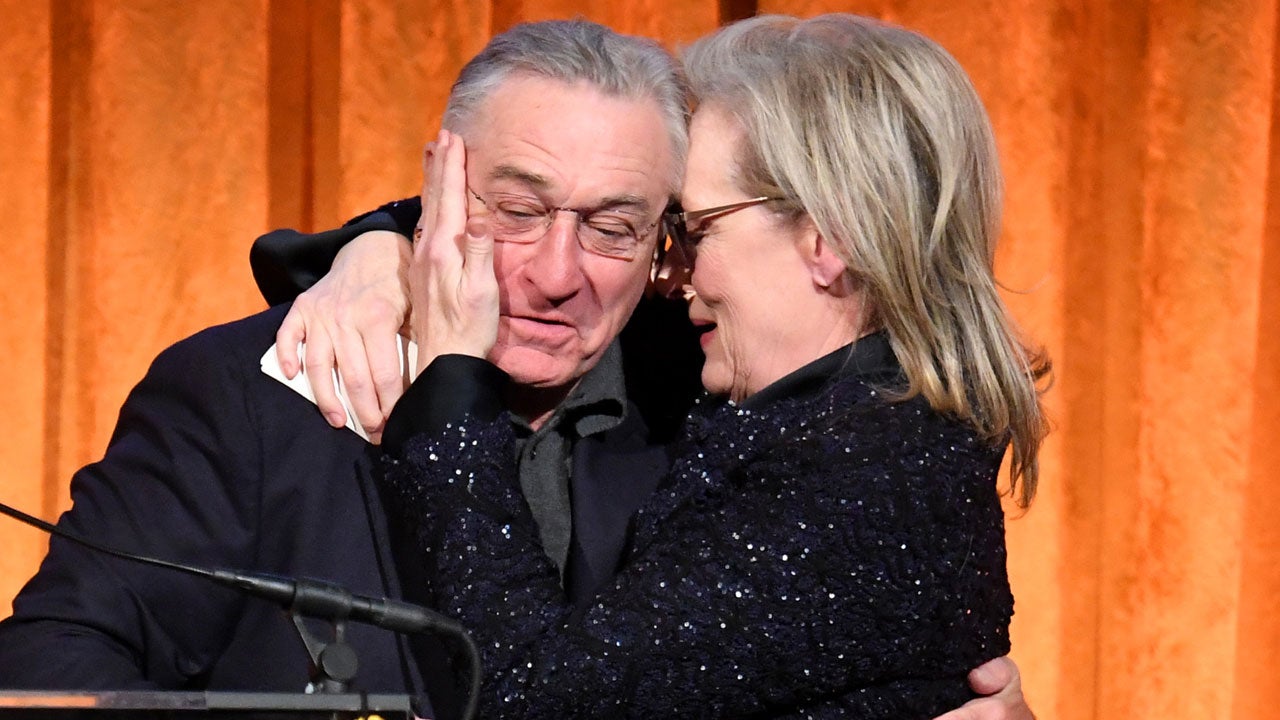
Several sources are reporting that Meryl will be attending "A Celebration of Film" at the University of Texas on September 24 to honor Robert De Niro. De Niro has apparently provided a portion of the endowment to the University's film preservation archives, and they're holding a gala to raise additional funds.
I normally don't report on news like this. I prefer to mostly keep my posts to items relating to Meryl's screen career. Not that it's ever a bad idea to promote good works or charitable contributions, but it's not really the goal of this blog to cover Streep's activities unrelated to her own work. I thought I'd make an exception in this case, however, since we've heard almost nothing about her since the very early part of the year. I've seen speculation online that she's critically ill, that she's decided to retire, that she's separated from her husband. I guess any of those could technically be true for all I know (I doubt any of them are), but I was pleased to see that Meryl is alive and likely well and likely just taking one of her usual extended breaks from filming.
I'm looking forward to news or release details for her upcoming anthology series Extrapolations. And like I've said recently, it could be any day that we learn of plans for her next big project. Patiently waiting.